Editor's pick
Best budget buy
Spec plate
Osaki Titan Quantum
3D · mid tier
- Price
- £811
- Mechanism
- 3D
- Track
- SL-track
- User height
- —
- Weight limit
- 118kg
- Recline clearance
- —
Guides / The big guide
Nine chairs from £811 to £8,000, chosen from a 30-chair database of manufacturer specifications and dated price checks. We have not sat in any of them — and unlike most lists, we say so. Every pick carries a genuine drawback, and the number that decides most purchases is one almost nobody prints: the gap a chair needs behind it to recline.
Reclinery is reader-supported: retailer links on this page may earn us a commission, which never affects what we recommend. How we make money.
| Chair | Best for | Price | Mechanism | Track | Wall gap |
|---|---|---|---|---|---|
| Osaki Titan Quantum | Best budget buy | £811 | 3D | SL-track | — |
| ROTAI RT6891 | Best under £1,500 all-rounder | £1,400 | 3D | SL-track | — |
| Synca CirC | Best compact chair | £999 | — | SL 88.9cm | — |
| Naipo Tai Chi Flow P50 | Best for small rooms | £1,699 | 2D | 135cm rail | 5cm |
| Real Relax PS5200 | Best value mid-range | £1,820 | 4D | SL-track | — |
| Komoder Focus II | Best mid-premium | £2,490 | 3D | — | 5cm |
| Komoder Opera Plus | Best for tall users | £4,290 | 3D | SL 135cm | — |
| OGAWA Master Drive 2 | Best luxury 4D | £8,000 | 4D | SL 134cm | — |
| Fujiiryoki JP-2000 | Best Japanese-made | £7,190 | 4D | — | — |
Figures from the Reclinery database, checked on the dates stamped on each plate. A dash means unpublished.
Most "best massage chair" pages are written backwards. They start with whichever chair pays the highest commission, sprinkle five-star ratings over it, and work out the justification afterwards. This page is built the other way round: from a database of 30 chairs' manufacturer specifications, with every price checked on a dated basis, every published figure traceable to a spec sheet, and every missing figure flagged as exactly that — missing.
Here's the buying order that actually works, and it's not the one the adverts suggest: room first, body second, mechanism third, budget last.
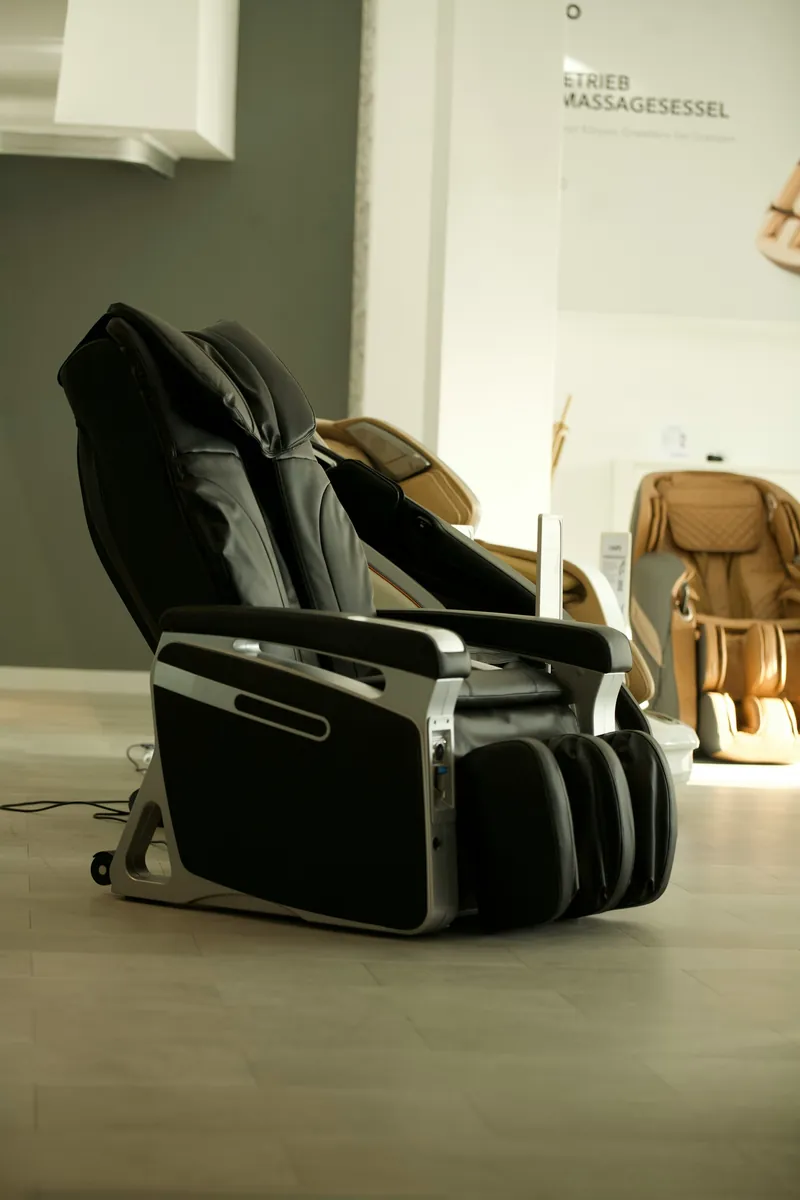
A massage chair fails in more homes for reasons of geometry than of massage quality. Three numbers decide it, and manufacturers publish them with wildly varying honesty.
The wall gap. This is our signature obsession, because it's the figure that decides whether a chair lives with you or against you. A reclining chair rotates backwards; unless it's engineered to slide forward as it reclines, the backrest needs free air behind it. Most brands either bury this number or don't publish it at all. The Naipo Tai Chi Flow P50 states 5cm of clearance; the Komoder Focus II states 5cm. Synca publishes 15.2cm for the CirC+, and OGAWA states 6cm for the MySofa Luxe. Everyone else in our database leaves you to find out on delivery day. If a brand won't print its wall gap, budget 25cm and count anything better as a bonus.
The reclined footprint. Upright dimensions flatter every chair. The Fujiiryoki JP-2000 occupies 118cm of depth upright but stretches to 200cm reclined. The Komoder Aurora reaches 210cm. Measure your floor against the reclined figure, not the showroom pose.
The door. A standard UK internal door is 762mm. The P50's largest box is 76cm wide — borderline. Real Relax states a 73.7cm minimum door for the Favor-06 and ROTAI states 79cm for the RT6891, which is precisely the kind of unglamorous honesty we rate. Boxes are heavy, too: 75kg for the P50, 97.6kg for Real Relax's PS5200. If your route in involves stairs, white-glove delivery stops being a nicety.
Then comes your body. Published height and weight envelopes vary more than you'd expect: the Synca CirC tops out at a stated 178cm, while the Komoder Opera Plus claims fit up to 200cm and the Fujiiryoki JP-2000 spans 150–198cm. Weight limits range from 100kg on the ROTAI to 159kg on the FURNIMAT — and plenty of expensive chairs don't publish one at all.
Only then does the mechanism matter (we explain 2D, 3D, 4D and track types below), and only after all of that should the budget conversation start. A 4D chair that doesn't fit your room, or whose rollers stop at your shoulder blades because you're taller than its scan envelope, is worse than a 2D chair that fits.
One more thing before the picks: massage chairs are comfort and relaxation products, not medical devices, and nothing on this page is health advice. If you have a health concern of any kind, talk to a GP or physiotherapist before spending this sort of money.
We should be upfront about what this guide is and isn't, because the category is drowning in reviews that pretend to be something they're not.
We have not sat in these chairs. No hands-on testing happened here, and we won't imply otherwise. Every claim on this page is based on manufacturer specifications, warranty terms and verified owner feedback, compiled into a structured database and checked against retailer listings on a stated date. That's a real limitation — a spec sheet can't tell you whether a roller feels precise or clumsy. But we'd argue it still beats the alternative: the five-star listicles that also haven't sat in the chairs, and lie about it. A dated, sourced spec is honest evidence. An invented "our tester loved it" is not.
Every figure comes from the database. The numbers in this guide are rendered directly from our chair database at build time, so they cannot drift out of date silently. When a price changes, the page changes with it, and every price carries its check date.
Null means unpublished, and we say so. When a manufacturer doesn't publish a spec — a warranty term, a weight limit, a track length — we don't guess, average, or quietly copy a rival's figure. We tell you it's unpublished, because a gap in a spec sheet is itself useful information about a brand.
Every pick has a drawback. If we can't find a genuine downside, we haven't researched the chair properly. You'll find one attached to every recommendation on this page, sourced from the same specs and owner feedback as the praise.
Affiliate links never affect ranking. Some retailer links on this site earn us a commission; most of our database, including several picks here, links to retailers that pay us nothing. The picks would be identical either way — several of our top recommendations earn us precisely £0.
The picks table above gives the summary; here's the reasoning, walking up the price ladder.
This tier exists because full-body massage chairs stopped being a five-figure purchase. What you give up is refinement, documentation and after-sales structure — not necessarily features. It has also thinned since our last price check: the FURNIMAT 4D SL-Track, long the £730 spec-per-pound oddity of this band, has risen to £900 and is currently unavailable at its Amazon listing, which leaves exactly two chairs here you can actually order.
The Osaki Titan Quantum at £811 is now both the tier's headline and the cheapest chair in the database: an established US massage-chair brand sold through its official UK seller, with 3D rollers on an SL track, voice control, zero gravity and heat in the back and calves. The honest gaps: Osaki publishes no track length, no programme count and no warranty term for it, the stated weight limit is 118kg, and UK owner feedback suggests the fit suits shorter users best. A known name with thin paperwork — the reverse of the usual budget trade.
The Synca CirC at £999 answers a different question: what if the chair has to look like furniture? At 54.9cm wide it's the smallest thing in our database by some distance, with white-glove delivery included — unheard of at this price. The trade is coverage: a 88.9cm track and a stated 178cm height ceiling, with the mechanism type, warranty and weight limit all unpublished. Small room, smaller user, minimal fuss: this is the pick.
The value sweet spot, where the choice stops being "which compromises" and becomes "which strengths". Four chairs earn places for four different buyers.
The ROTAI RT6891 at £1,400 is the sensible entry to the tier — and a recent arrival in it, after a price rise took it past the £1,000 line: an established massage-chair manufacturer, a 2-year warranty, 3D rollers, heat in the back and calves, and a published minimum door width. Its stated 100kg weight limit is the tightest of our picks, and in-home assembly costs extra — but as a first serious chair with real paperwork behind it, it's the strongest sub-£1,500 case in the database.
The Real Relax PS5200 at £1,820 is the feature-count choice: a 4D-badged mechanism on an SL track, zero gravity, body scan, 30 airbags and 20 auto programmes — the deepest published list under £2,000 in our database — with a stated 149–189cm fit. Against that: a 1-year warranty with UK terms unpublished where the best in class give three, few UK owner reviews so far, and kerbside delivery of a 97.6kg box. (Its heavily reviewed sibling, the Favor-06, is currently unavailable — the Amazon listing it sold under now shows a different product entirely; see our review.)
The Naipo Tai Chi Flow P50 at £1,699 is the small-room specialist and the reason this site cares so much about wall gaps: a published 5cm clearance, a long 135cm rail, heat in back and calves, and a stated height range of 150–195cm that covers households most chairs split. Its rollers are 2D at a price where 3D exists — read the full review for the complete accounting — but if the gap behind the chair is your constraint, nothing else in the database touches it.
The Komoder Focus II at £2,490 tops the tier by buying you an ownership experience as much as a chair: white-glove delivery and installation by a UK seller, a 3-year warranty, and the same 5cm wall clearance as the P50 with a 3D mechanism, body scan and voice control on top. Our gripe is documentation: Komoder doesn't publish the track type, track length or airbag count, which is an odd gap for a brand this established. Reclined, plan for 188cm of floor.
This tier exists for buyers who'd rather pay for support, fit and build than for feature-count fireworks. The step up over mid-tier is rarely the massage itself — it's longer warranties as standard, white-glove installation as standard, and engineering for bodies the cheaper chairs ignore.
Our pick is the Komoder Opera Plus at £4,290, and the reason is height. Its stated fit runs to 200cm, which almost nothing else in the database matches, on a 135cm SL track with calf kneading, an extending footrest and heat in the back and calves. Warranty is 3 years with white-glove installation included. The honest caveats: it's a single 3D mechanism at a price point where 4D rivals exist, Komoder publishes no body-scan spec for it, and at 160cm deep upright — 192cm reclined — it wants a big room. Tall users have been an afterthought in this category for years; this is the chair that isn't one.
Above £5,500 you're buying flagship mechanisms, deep programme libraries and, in one case, country of manufacture. Diminishing returns are real up here — the jump from a good mid-tier chair to a premium one is bigger than the jump from premium to luxury — but two chairs make a coherent case.
The OGAWA Master Drive 2 at £8,000 is the technology play: a 4D mechanism on a 134cm SL track, biometric scanning, and 24 auto programmes — the deepest library in OGAWA's UK range — with a 3-year warranty and white-glove installation. And yet the spec sheet has luxury-priced gaps: no heat function is listed, and no user height or weight limits are published. At this price we'd expect a brand to print everything.
The Fujiiryoki JP-2000 at £7,190 is the provenance play: made in Japan by the company that has been building massage chairs longer than anyone, with AI dual body scanning, 60 auto programmes, heat in the back and feet, a full-flat recline and the widest stated height range in our database at 150–198cm. Sold and installed by the UK distributor. Its weakness is, again, paperwork: the UK listing publishes no warranty term, no track length and no weight limit, so confirm terms in writing before parting with £7,190.
2D / 3D / 4D describes the rollers' axes of movement. 2D rollers travel up-down and side-to-side. 3D adds in-and-out travel, so pressure depth becomes adjustable. 4D adds independent control of the speed and rhythm of that in-and-out motion. More axes generally means a more adjustable feel — but implementation beats arithmetic, which is why a 2D chair sits in our mid-tier picks and a 4D chair sits in budget.
S, L and SL tracks describe the rail the rollers ride. An S-track follows the curve of the back from neck to lower back. An L-track continues under the seat. An SL-track does both, typically running 120–140cm — the 138.9cm rail on the FURNIMAT and 135cm on the Opera Plus are typical of a full-length SL. Longer generally means more of you gets covered; note that some brands, Naipo's P50 among them, use proprietary rail designs they don't classify.
Zero gravity is a recline posture, not a feature of the massage itself: the legs raise to roughly heart level and the body's weight settles into the backrest, which many owners find lets the rollers press with more apparent depth. Almost every chair in our database offers it now; its real cost is floor space when reclined.
Heat and programmes round out most spec sheets, and both reward a sceptical read. Heat zones vary — back only is the norm, back and calves is common, and back and feet (as on the Fujiiryoki JP-2000) is rarer — and a chair with no heat listed usually means no heat fitted, though for some brands it simply means unpublished; we flag which is which wherever the database lets us. Auto programme counts run from 2 on Naipo's Model U to 60 on the JP-2000, but the number is a weak proxy for quality: most owners settle on two or three favourites within a fortnight, so a well-judged six beats a padded forty.
Power draw is the least of your worries. Published figures in our database run from 80W to 290W — less than most kettles use in a fraction of the time — which is why a session costs pennies. Standby draw is the figure to ask about, since chairs tend to stay plugged in for years and almost no manufacturer publishes it.
Wall gap — the clearance a chair needs behind it to recline — is the spec we wish the industry took seriously. Four brands in our database publish it; the rest don't. When it's published it ranges from 5cm to 15.2cm. When it isn't, assume 25cm and check on delivery.
No named hit-jobs — patterns are more useful than grudges, and the same warning signs recur across the category.
Chairs with unpublished weight limits at low prices. A weight limit is a structural engineering claim. Premium brands sometimes omit it out of spec-sheet laziness, which is bad enough; a sub-£1,000 chair that omits it gives you no basis for a warranty claim when the frame complains. If the limit isn't printed, ask the seller in writing before buying — a seller who won't answer is an answer.
Marketplace listings with no brand website. A worrying share of cheap massage chairs exist only as a marketplace listing: no manufacturer site, no UK entity, no parts channel, no one to honour year two of a warranty that was only ever a returns window. A massage chair is a 70–100kg electrical appliance you'll own for years. Before buying any chair, find the manufacturer's own website and a UK contact route. If neither exists, walk away — the discount is the support budget.
Sub-£300 "massage recliners". These are vibration pads inside an ordinary recliner: no rollers, no track, no mechanism in the sense this guide uses the word. They're not a scam — some people enjoy them — but they are a different product category, and listings that borrow full-chair language ("full body", "shiatsu", "zero gravity") without a roller track are trading on the confusion. Every chair in our database has a genuine roller mechanism; that's the entry bar.
Out-of-stock recommendations. Any guide is only as good as its date. Several chairs in our wider database — HOMCOM's range among them — are currently listed out of stock at their UK retailers, so they're excluded from the picks above regardless of merit. Our prices were last checked on 2026-09-20; if what you see at a retailer differs, trust the retailer and tell us.
The short version of this entire guide: measure the room, measure the doorway, check the published fit envelope against the tallest and heaviest people who'll use the chair, and only then compare mechanisms and prices. The chairs above are the nine strongest cases in a 30-chair database as of the date stamped on their prices — with every drawback we could find printed right next to the praise, which is more than most of this industry manages.
Best budget buy
The cheapest chair you can actually buy in our database: a recognised US massage-chair brand, sold through its official UK seller, bringing 3D SL-track rollers, voice control and heat in the back and calves to £811, with a stated 118kg weight limit.
Worth knowing: Track length, programme count and warranty term are all unpublished, and UK owner feedback suggests the fit suits shorter users best — taller households should look further up this list.
Osaki Titan Quantum
3D · mid tier
Best under £1,500 all-rounder
A well-reviewed 3D chair from an established massage-chair maker at £1,400, with heat in the back and calves, 22 airbags and a proper 2-year warranty — rare documentation at this price. ROTAI also publishes a minimum door width of 79cm, which most brands leave you to guess.
Worth knowing: The stated user weight limit is a modest 100kg, the lowest of our picks, and delivery is kerbside — in-home unpacking and assembly is a paid extra.
ROTAI RT6891
3D · mid tier
Best compact chair
A Japanese-brand chair styled as ordinary furniture: 54.9cm wide, 99cm deep and £999, with back heat, five auto programmes and white-glove delivery included. For flats and shared rooms where a full-size recliner would dominate, nothing else in the database is this discreet.
Worth knowing: The stated height ceiling is 178cm and the track is a short 88.9cm, so taller users get limited coverage. Synca also leaves the mechanism type, weight limit and warranty term unpublished.
Synca CirC
mid tier
Best for small rooms
The wall-gap champion: a published 5cm recline clearance, where rivals typically need 15–25cm or simply don't say. At £1,699 you get a long 135cm rail, 24 airbags, heat in the back and calves, and one of the widest stated height ranges under £2,000: 150–195cm.
Worth knowing: The rollers are 2D at a price where 3D and 4D mechanisms exist — ROTAI's RT6891 is 3D at £1,400. Room fit is the reason to buy this chair, not massage depth.
Naipo Tai Chi Flow P50
2D · mid tier
Best value mid-range
The deepest feature list under £2,000 in our database: a 4D-badged mechanism on an SL track, zero gravity, body scan, 30 airbags and 20 auto programmes for £1,820, with a stated height range of 149–189cm.
Worth knowing: The warranty is 1 year with UK terms unpublished where Komoder gives three, it is a newer UK listing with few owner reviews so far, and the 97.6kg box arrives at your kerb, not in your room.
Real Relax PS5200
4D · mid tier
Best mid-premium
Komoder's self-described UK best-seller earns its place on the ownership experience: £2,490 buys a 3D chair with body scan, voice control and back heat, delivered and installed white-glove by a UK seller with a 3-year warranty. It shares the P50's party trick — a published 5cm wall clearance — and reclines into 188cm of floor.
Worth knowing: Komoder doesn't publish the track type, track length or airbag count for the Focus II, which makes its roller coverage hard to compare on paper against SL-track rivals.
Komoder Focus II
3D · mid tier
Best for tall users
One of very few chairs in our database with a stated fit up to 200cm. For £4,290 you get a 3D mechanism on a 135cm SL track, heat in the back and calves, an extending footrest, white-glove installation and a 3-year warranty.
Worth knowing: It is a single 3D robot at a price where 4D mechanisms exist, Komoder doesn't publish a body-scan spec for it, and at 160cm deep upright it needs a genuinely large room.
Komoder Opera Plus
3D · premium tier
Best luxury 4D
OGAWA UK's flagship: a 4D mechanism on a 134cm SL track with biometric scanning and a 24-programme library, the deepest in their range, at £8,000 with white-glove delivery and a 3-year warranty. This is the chair for buyers who want the programme depth of a hotel-spa machine at home.
Worth knowing: For the money, the published spec sheet has odd gaps: OGAWA lists no heat function and no user height or weight limits for it, so bigger and smaller users are buying on trust.
OGAWA Master Drive 2
4D · luxury tier
Best Japanese-made
The only made-in-Japan pick on this list: Fujiiryoki's £7,190 JP-2000 pairs a 4D mechanism with AI dual body scanning, 60 auto programmes, heat in the back and feet, and a stated height range of 150–198cm — the widest in our database. Sold and installed by the UK distributor.
Worth knowing: The published UK spec sheet is sparse for the price: no warranty term, no track length and no user weight limit are listed, so you'll need to confirm terms with the distributor before ordering.
Fujiiryoki JP-2000
4D · luxury tier
That depends entirely on use. A chair used daily for relaxation costs pennies per session over its life; one used twice and abandoned is the most expensive footstool in the house. The honest maths: a £1,400 chair used four times a week for five years works out around £1.35 per session before electricity. If you already pay for regular massages, the comparison is easy to run — if you've never enjoyed one, try a chair in a showroom before committing.
Our database runs from £811 to £8,000. Broadly: £811–£1,000 buys real full-body chairs with compromises in refinement or documentation; £1,000–£2,500 is the value sweet spot; £2,500–£5,500 adds UK-seller support, white-glove installation and longer warranties; above £5,500 you're paying for flagship 4D mechanisms and, in some cases, Japanese manufacture.
The rollers' freedom of movement. 2D rollers move up-down and side-to-side across your back. 3D adds in-and-out travel, so the rollers can press deeper or back off. 4D adds independent speed and rhythm control over that third axis. More Ds generally means a more adjustable massage — but a well-tuned 2D chair can feel better than a crude 4D one, which is why we never rank on mechanism alone.
Check three numbers before you fall for a chair: the boxed width against your narrowest door or hallway (a standard UK internal door is 762mm), the reclined footprint against your floor space, and the wall clearance the chair needs to recline. Our fit checker runs all three against every chair in the database.
Very little. Published power draws in our database run from about 80W to 290W — at the current UK price cap, a one-hour session on a typical 90W chair costs roughly 2–3 pence. The bigger running-cost questions are standby draw, which most manufacturers don't publish, and out-of-warranty repairs.
Kerbside means the courier leaves the boxes — often 75–100kg of them — at your door, and getting them upstairs and assembled is your problem. White-glove means the seller's team carries the chair to your room of choice, assembles it and removes the packaging. On a 100kg-boxed chair this is not a luxury; check whether it's included, a paid add-on, or not offered at all before comparing prices.
No, and we make no health claims for any chair on this site. Massage chairs are comfort and relaxation products. If you have a health concern of any kind, talk to a GP or physiotherapist before buying one.