Editor's pick
2D example
Spec plate
Naipo Tai Chi Flow P50
2D · mid tier
- Price
- £1,699
- Mechanism
- 2D
- Track
- 135cm rail
- User height
- 150–195cm
- Weight limit
- 130kg
- Recline clearance
- 5cm
Guides / Jargon, decoded
The 2D/3D/4D label is the most quoted and least policed spec in the massage-chair market. Here is what each class actually describes, why a £900 chair and an £8,000 chair can wear the same badge, and how to match the mechanism to the massage you actually want.
Reclinery is reader-supported: retailer links on this page may earn us a commission, which never affects what we recommend. How we make money.
| Chair | Best for | Price | Mechanism | Track | Wall gap |
|---|---|---|---|---|---|
| Naipo Tai Chi Flow P50 | 2D example | £1,699 | 2D | 135cm rail | 5cm |
| ROTAI RT6891 | 3D example | £1,400 | 3D | SL-track | — |
| FURNIMAT 4D SL-Track | 4D at £900 | £900 | 4D | SL 138.9cm | — |
| OGAWA Master Drive 2 | 4D at £8,000 | £8,000 | 4D | SL 134cm | — |
Figures from the Reclinery database, checked on the dates stamped on each plate. A dash means unpublished.
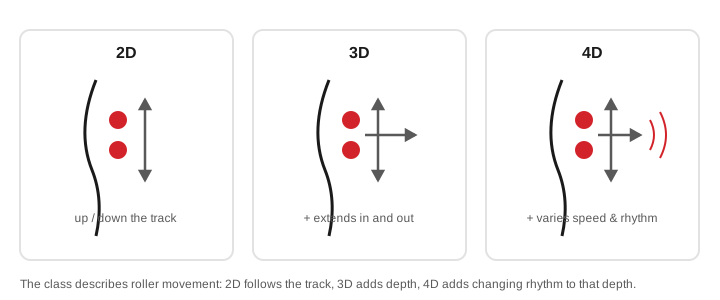
Every massage chair moves a pair of rollers along a track behind your back. The 2D/3D/4D label describes what else those rollers can do — and nothing more.
2D rollers move along the track (up–down) and across it (side to side) at a fixed depth. Pressure is consistent and predictable; you adjust it, if at all, with spacing or a cushion, not the mechanism.
3D rollers add a third axis: they extend towards you and retract away, varying how deeply they press. This is the class most people are imagining when they picture a "proper" massage chair, and it is where depth adjustment genuinely lives.
4D is 3D plus control over the rhythm and speed of that extension — the rollers can slow into a press, ease off, and change tempo mid-stroke rather than extending at one fixed rate. Done well it feels less mechanical. That "done well" is the entire catch, as the two 4D picks below demonstrate.
Anything above 4D is branding. Fujiiryoki markets its flagships as "5D AI", and we record the £7,190 JP-2000 and £7,900 JP-3000 as 4D in our database, because that is what the mechanism is.
Here is the uncomfortable truth from our own database: the mechanism class is self-declared, unaudited, and free.
The FURNIMAT 4D SL-Track costs £900 and calls itself 4D. The OGAWA Master Drive 2 costs £8,000 and calls itself 4D. Same badge — and around it, completely different depths of published specification. The OGAWA states a 3-year warranty, white-glove installation, body scanning and 24 programmes; the FURNIMAT publishes no warranty term and no delivery service, and owner feedback flags an intensity that cannot be turned down. Nobody verifies either claim of "4D". The label tells you the design intent; the spec sheet around it tells you whether to believe the execution.
Meanwhile, plenty of credible chairs state no class at all — both Panasonic models we track, OGAWA's £5,000 Cosmo X 2 and the entire Synca CirC range publish no 2D/3D/4D designation. An unstated class is not a red flag; an unverifiable one dressed up as a headline sometimes is.
Based on manufacturer specifications, warranty terms and verified owner feedback, here is how we steer people.
Choose 2D if you want gentler, more consistent pressure and a simpler chair. The Naipo Tai Chi Flow P50 at £1,699 shows the class at its best: a long 135cm rail and heavy airbag support doing the work the third axis would otherwise do. Many buyers — particularly those choosing a first chair or one for an older relative — end up preferring exactly this feel.
Choose 3D as the default. The ROTAI RT6891 at £1,400 gets you genuine depth adjustment from an established maker with a 2-year warranty. Most people's ideal massage lives somewhere in the 3D range, and the price of entry is now under £1,500 — or £811 via the Osaki Titan Quantum, if its thinner paperwork doesn't put you off.
Choose 4D only if depth and rhythm are the reason you are buying — and then buy the execution, not the badge. That usually means the £5,000-plus tier, where the mechanism comes with scanning, long warranties and installation.
Price, in other words, does not buy you a class. It buys tuning, materials, warranty and service around whichever class you pick.
A worked example from the middle of the market: the 2D Naipo P50 costs £299 more than the 3D ROTAI, and £799 more than the self-declared 4D FURNIMAT. If the label were the spec, that ordering would be absurd. It is not absurd, because the P50 brings a published wall clearance, wider stated height range, white-glove delivery and a longer feature list around a simpler mechanism. Mechanism class is one axis of value among many — read any listing that leads with "4D" and says little else as a prompt for questions, not a reason to buy.
The mechanism is one line of the spec sheet. Track length decides how much of your back the rollers reach; your height against the stated range decides whether the shoulder rollers land where they should — check yours with our Body Fit tool. Footprint and wall clearance decide whether the chair fits your room at all: our Will It Fit tool takes a minute. And when two chairs both wear the right label, our comparison tool shows which one backs it up — or start from the shortlist in our best massage chairs in the UK guide.
2D example
A textbook modern 2D chair: fixed-depth rollers travelling a long 135cm rail, backed by 24 airbags. Predictable, consistent pressure — exactly what 2D is for.
Worth knowing: Depth is set by the chair, not by you. If the roller sits too light or too firm for your back, a 2D mechanism has no extend-and-retract adjustment to fix it.
Naipo Tai Chi Flow P50
2D · mid tier
3D example
Rollers that extend and retract to vary depth, on an S+L track, from an established massage-chair maker with a 2-year warranty — the mechanism sweet spot at under £1,500.
Worth knowing: A modest 100kg stated weight limit, and delivery is kerbside by default — in-home unpack and assembly is a paid extra.
ROTAI RT6891
3D · mid tier
4D at £900
Proof the label is free: a self-declared 4D mechanism, a long 138.9cm SL track and 22 programmes for less than some 2D chairs.
Worth knowing: Owner feedback reports the roller intensity cannot be turned down, and FURNIMAT publishes no warranty term or delivery service — the spec around the 4D badge is thin. It is also currently unavailable at its Amazon listing.
FURNIMAT 4D SL-Track
4D · mid tier
4D at £8,000
The same 4D label, executed at flagship level: biometric scanning, 24 programmes, a 3-year warranty and white-glove installation. This is what the price difference buys — execution, not classification.
Worth knowing: OGAWA publishes no heat function for it — unusual at this price, where back and calf warmth is close to standard — and the outlay is roughly nine Furnimats.
OGAWA Master Drive 2
4D · luxury tier
No. 4D adds variable rhythm and speed to the 3D extend-and-retract action, but the label says nothing about build quality, warranty or how well the movement is tuned. A well-executed 3D chair can be a better buy than a cheap 4D one.
Marketing. Fujiiryoki brands its flagship mechanisms '5D AI', and we record those chairs as 4D in our database because no fifth axis of movement exists. Anything above 4D is a branding exercise, not an engineering class.
Several models in our database — including chairs from Komoder, Synca, Panasonic and OGAWA — publish no 2D/3D/4D class. Sometimes the architecture does not map neatly onto the labels; sometimes the brand simply does not use them. Judge those chairs on track length, programmes and warranty instead.
For most buyers, 3D: adjustable depth without flagship prices. Choose 2D if you want gentler, more predictable pressure or a simpler chair; consider 4D only if massage depth and rhythm are the main reason you are buying.
Not directly — footprint is set by the chair design, not the roller class. A 2D chair can be large and a 4D chair compact. Check any chair against your room with our Will It Fit tool.